Book by Thomas Douniès, Vanille Laborde and Guillaume Silhol (ed.): «Fabrique politique de l'École, fabrique scolaire du politique».»
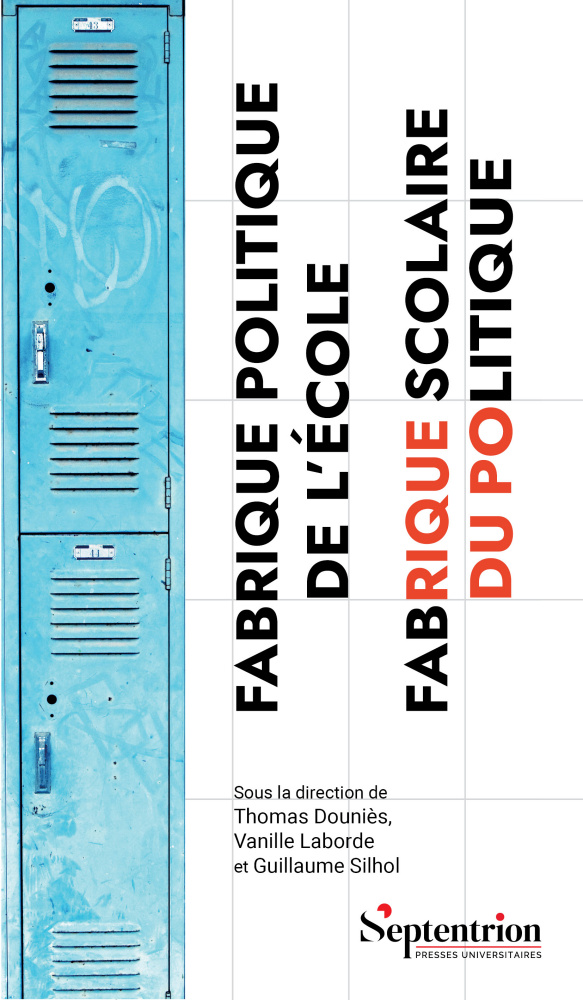
Thomas Douniès, Vanille Laborde, Guillaume Silhol (ed.), The political production of schools and the production of politics in schools, Presses Universitaires du Septentrion, Paradoxa collection, 2026, 404p. (ISSN 25528203 - EAN 9782757445860)
Summary:
An invitation to think about schools as spaces of power, legitimisation and political uprising. Read more
Who governs schools today? What role does it play in tackling societal problems and regulating relations between social groups? To what extent is it still, or more than ever, a crucible for political mobilisation and behaviour? Using a resolutely multidisciplinary approach - combining sociology, political science, history, geography and education sciences - this book sheds new light on the contemporary forms of the link between schools and politics, analysing the political shaping of the school order and the school shaping of the social and political order. From educational policies to parental mobilisation, from ministerial reforms to the ordinary resistance of those for whom they are intended, the contributions show the school as a decisive cog in the wheel and a key battleground in the exercise of public power, which is in the process of being reconfigured. They also show the importance of the educational institution in the stratification of social space beyond diplomas, as well as its importance in the politicisation of individuals, facts and social relations.
A stimulating invitation to think of schools as spaces of political power and uprising.
Contents
General introduction.
School and politics: towards a multidisciplinary renewal of analyses
Thomas Douniès, Vanille Laborde, Guillaume Silhol
Part I. Training, translation and school treatment of public problems
Introduction to Part I
Ludivine Balland
Chapter 1. The conditions for importing the problem of the «lack of social openness of the grandes écoles» into the educational establishment
Alice Pavie
Chapter 2. Teaching money at school: from the politicisation of an educational problem to the schooling of a public problem?
Marion Clerc
Chapter 3. What the tool says about the problem. Equipping «at-risk school groups» since the 2000s
Hélène Buisson-Fenet
Chapter 4. The administrative domestication of a controversy surrounding the «secular problem»: when canteen refunds for Ramadan cause controversy on Twitter Vanille Laborde
Part II. Population differentiation and the political construction of social boundaries by schools
Introduction to Part II
Fabrice Dhume
Chapter 5. Vocational high schools: from stated political ambitions to school realities. Social and gendered inequalities in vocational baccalaureates in the care and personal services sectors
Séverine Depoilly
Chapter 6. The ordinary ambivalences of specialised schooling. Configurations and reconfigurations of the dilemma of difference in the light of disability policies
Célia Bouchet
Chapter 7. Foreigners at the school gates. The production of national borders at the counters of the welfare state
Thomas Douniès
Chapter 8. Choosing your school, choosing sides? The challenges of educating Algerian pupils during the Algerian War of Independence
Christine Mussard
Chapter 9. The righting of the State's left hand. Internalizing migration control at school and legal battles in South Africa
Jeanne Bouyat
Part III. The interweaving of school and political socialisation
Introduction to Part III
Géraldine Bozec
Chapter 10. «We're here for the course, not to talk about the strike! Students» socially differentiated understanding of the relationship between the academic order and the political order
Noé Fouilland
Chapter 11. Between the pedagogy of uprooting and maintaining ties with the original school context. Education professionals and the socialisation of «socially open» groups»
Magali Nonjon, Camille Floderer
Chapter 12. Professional socialisation as political socialisation. School policies in the light of the representations of beginning teachers in public secondary general and technological education
Nada Chaar
Chapter 13. Competing socialisations and the politicisation of precarious teaching: a case study in Italy
Guillaume Silhol
Part IV. Schools as objects and means of political struggle
Introduction to Part IV
Lorenzo Barrault-Stella
Chapter 14. Activism in and against the educational institution. Mobilising for a different kind of state school at the turn of the millennium
Marie-Charlotte Allam
Chapter 15. The ways in which conflictual relations between parents and the state are constructed. The case of parental disputes in Seine-Saint-Denis
Félicie Roux
Chapter 16. Involvement in alternative forms of non-contract schooling: politicisation with or against the State?
Marie Doga, Valérie Larrosa, Fanny Parent
General bibliography
Biographical notes
Share on
Read also