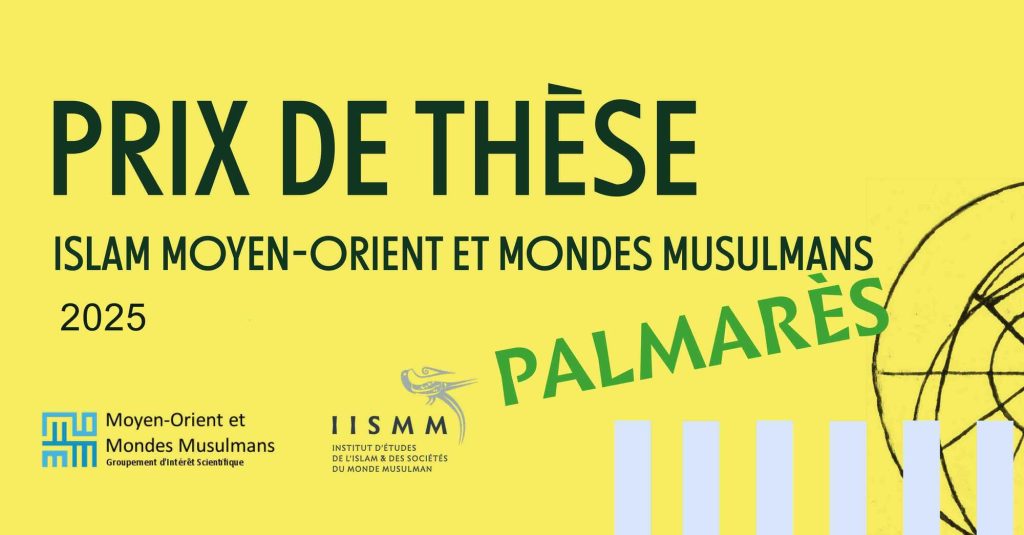
The Middle East and Muslim Worlds Scientific Interest Group (GIS MOMM) and the Institut d'étude de l'Islam et des sociétés du monde musulman (IISMM) are pleased to publish the 2025 winners of the Islam, Middle East and Muslim Worlds Awards (IMOMM).
Following the evaluation of the 66 entries received and the jury's deliberations, three thematic prizes and 2 mentions were awarded, as well as two GIS MOMM and IISMM prizes and 3 mentions.
→ The Rémy Leveau Prize, awarded by the Bureau central des cultes, was awarded to Lucas FAURE for his thesis: «Gouverner le social par le religieux: les ONG humanitaires musulmanes en France» (Governing social affairs through religion: Muslim humanitarian NGOs in France)», directed by Franck FREGOSI, to be defended in 2023 in Aix-en-Provence.
→ Audrey PLUTA was awarded the IISMM Prize for his thesis «The order of democracy: police unions and security «reform» professionals in Tunisia (2011-2021)», directed by Eric GOBE (IREMAM / Aix-Marseille-Université) and Amin ALLAL (CERAPS / Université de Lille), and defended at the European Court of Human Rights. 18 November 2024 in Aix-en-Provence.
Congratulations to the winner!
AUDREY PLUTA, WINNER OF THE IISMM 2025 AWARD :
Summary of his thesis:
A pillar of Ben Ali's authoritarian regime, the police institution in Tunisia has been buffeted by seemingly opposing winds since January 2011: social demands and union struggles from below and demands for reform from outside. This thesis sheds light on the ways in which modes of domination are recomposed in a context where they have been put on the back burner, where their legitimacy has been challenged. In contrast to an attempt to classify political regimes, it shows the hybridisations and adaptations of social relations of coercion in a context of emerging authoritarianism, in which the police remain central. My approach was to decompartmentalise the sociology of institutions, public action and the police, by following the actors through repeated interviews between 2017 and 2021 with police trade unionists, security sector reformers and Ministry of the Interior executives. The local uses of participatory watchwords in police work, the possible non-existence of an overhaul of political control of the security forces and changes in police socio-professional conditions are all areas of investigation into changes in sectoral arrangements specific to security. «The title of this thesis, »The Order of Democracy«, embodies the practice of power that is typical of situations of »authoritarian restoration', involving composition with centrifugal forces, between demands for change in police methods and social demands for a return to order. In this sense, security sector reform policies and police anger converge towards a strengthening of the security institution, either by participating in its relegitimisation, or by obtaining areas of socio-professional autonomy for officers. In this way, this thesis contributes to the debate on the uses of coercion and how they are incorporated into the construction of public, political and social orders.
LUCAS FAURE, WINNER OF THE REMY LEVEAU PRIZE FOR ISLAM IN FRANCE AND EUROPE 2025 :
Summary of his thesis:
Originating in the UK, Muslim NGOs first appeared in France in the 1990s. Secours islamique France, Human Appeal, Muslim Hands, Ummah Charity, Syria Charity, Au Cœur de la Précarité and LIFE are just some of the emblematic associations. Since the 2010s, Muslim humanitarian NGOs have emerged as the most dynamic players in the field of Islamic associations, to the point where some have become long-term partners of the public authorities. Operating in major French cities, they are part of local solidarity networks, carrying out a range of activities (food distribution, outreach work, emergency accommodation, educational support, administrative assistance, etc.), while also running humanitarian programmes abroad. These associations also develop advocacy initiatives, speak out on political and media issues, and even denounce North/South relations of domination or social inequalities in France.
Through its socio-historical and ethnographic approach, this thesis sheds new light on Islamic humanitarian aid in France, in a secularised, minority and competitive environment marked by state interventionism. Contrary to the republican rhetoric that stigmatises denominationalism, the state delegates to Muslim NGOs a particularist management of Muslim publics. Recognition in the name of denominational usefulness is countered by denominational stigmatisation, which places Muslim humanitarian NGOs in a relationship of useful subordination to the State. A paradoxical injunction is therefore addressed to Muslims, who have to be «Muslim but not too Muslim». The paradox of the stigmatisation of associative actors, who are nonetheless essential to the government of social affairs by the religious, is thus at the heart of the study.
Share on
Read also