METISS Collective - Creative methods in research in the humanities and social sciences
METISS Collective « MEthodes créaTIves dans la recherche en Sciences humaines et SocialeS » (creative methods in research in the humanities and social sciences)»
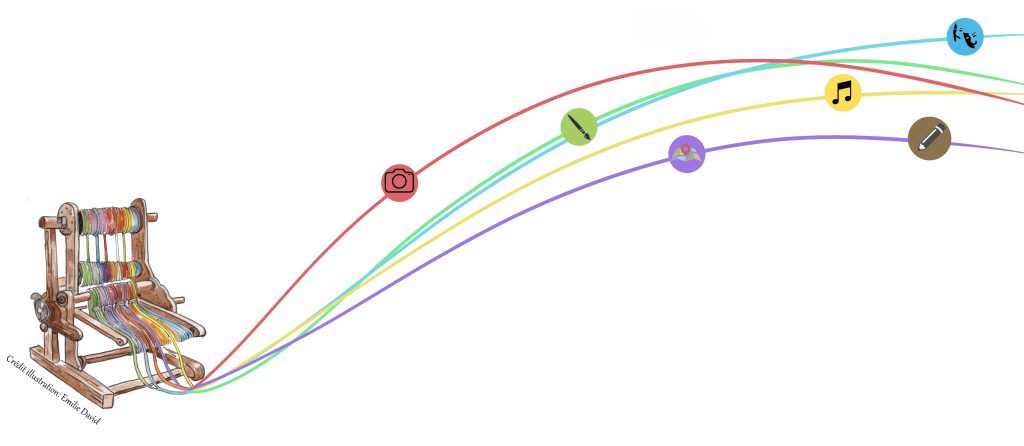
In September 2024, the METISS «MEthodes créaTIves dans la recherche en Sciences humaines et SocialeS» collective was formed, affiliated with three units: MESOPOLHIS [1], IREMAM [2] and URMIS-Nice [3]. Since September 2025, it has included a fourth unit, the LPED. [4]. Interdisciplinary, bringing together research support engineers, researchers and teacher-researchers, its ambition is to share a culture of enquiry that goes beyond the practice of interviewing and textual analysis, using photography, research through listening and sound immersion, sensitive or alternative cartography, comic strips and fanzines, and the performing arts. These methods of enquiry, which are partly linked to artistic practices, are both evidence of and part of a creative shift, as well as a reflexive and ethical shift, in research in the humanities and social sciences. What contribution do these methods make to research and, more broadly, to the production of knowledge? What relationships can they forge with the individuals at the heart of our research? How do they compare with more traditional approaches? What are their limitations, grey areas and stumbling blocks?
---
[1] The Centre méditerranéen de sociologie, de science politique et d'histoire (MESOPOLHIS, UMR 7064) is a multidisciplinary social science research unit under the triple supervision of Aix Marseille University, Sciences Po Aix and the CNRS. It is spread over two sites, the MMSH and the Espace Philippe Seguin in Aix-en-Provence.
[2] The Institute for Research and Studies on the Arab and Muslim World (IREMAM, UMR 7310) is a joint research unit between the University of Aix-Marseille and the CNRS. It is based at the MMSH in Aix-en-Provence.
[3] The Unité de Recherches Migrations et Société (URMIS, UMR 8245) is a joint research unit under the auspices of the Université Côte d'Azur, the Université Paris Cité, the Institut de recherche pour le développement and the CNRS. It is spread over two sites, the Université Côte d'Azur (Nice) and the Université Paris Cité.
[4] The Population Environment Development Laboratory (LPED, UMR 151) is an interdisciplinary laboratory at the interface between social sciences and the environment. It is under the joint supervision of Aix Marseille University and the Institut de Recherche pour le Développement (IRD).
Organising Committee
- Anne Tricot, geographer and methods engineer (Phd) at CNRS - MESOPOLHIS
- Sarah Andrieu, anthropologist and UniCA - URMIS teacher-researcher
- Cédric Parizot, anthropologist and director of research at the CNRS - IREMAM
Active members
- Sarah Andrieu, anthropologist and teacher-researcher UniCA - URMIS Nice
- Saïd Belguidoum, sociologist and research professor at Aix-Marseille University - IREMAM
- Jean-Baptiste Bertrand, statistician and CNRS engineer at MESOPOLHIS
- Maria-Elena Buslacchi, sociologist and post-doctoral researcher at MESOPOLHIS, Observatory of cultural audiences and practices
- Aline Chamahian, a sociologist and lecturer at Aix-Marseille University and researcher at MESOPOLHIS
- Sylvie Chiousse, a socio-anthropologist (Phd) and editor at MESOPOLHIS.
- Constance de Gourcy, a sociologist and HDR lecturer at Aix-Marseille University and researcher at MESOPOLHIS.
- Lama Kabbanji, demographer and researcher at the IRD, LPED - Marseille
- Cédric Parizot, anthropologist and director of research at the CNRS - IREMAM
- Francesca Sirna, sociologist and researcher at the CNRS - URMIS-Nice
- Anne Tricot, geographer and engineer (Phd) methods at the CNRS MESOPOLHIS
- Elisa Ullauri Llore, sociologist and post-doctoral researcher at MESOPOLHIS, Observatory of cultural audiences and practices
METISS meetings
METISS meetings are based on a shared desire to question what goes on «behind the scenes» in research, without this being reduced to highlighting anecdotes or describing ready-made recipes that can be applied to any situation or context. In response to these initial questions, the METISS meetings constitute a a place for exchange and reflection on methodologies, cross-fertilisation of practices between researchers from different disciplines and artists, and ethical and epistemological reflection. Another original feature of these meetings is that they allow time for breathing and dialogue by giving participants time to explain their approach and talk about a survey that has been completed or is in the process of being carried out.
For its 2025-2026 edition, METISS meetings will focus on plenary sessions (half-day or study day) at introductory methodological and reflective workshops.
Some sessions are organised in collaboration with axis 2 «Migrations, mobilities, circulations» of MESOPOLHIS, others in partnership with the MERs seminar on «Sensitive writing and research on migration».» dedicated to exploring creative practices in the study of migratory phenomena, itself hosted by the Centre Norbert Elias (Marseille).
Sessions and workshops 2025-2026



Focus on workshops
Coming soon
Documentation
Coming soon