METISS 2025 seminar & Axis 2, workshop session 6: «Sensitive data collection and multimodal approaches».»
Details
Some information about the annual «MEthodes créaTIves dans la recherche en Sciences humaines et Sociales» (METISS) seminar:
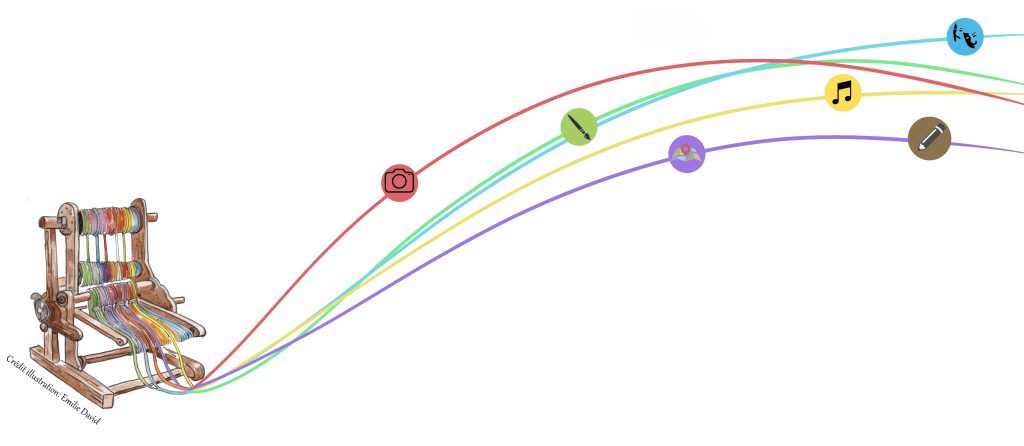
In September 2024, a an interdisciplinary group of research support engineers and teacher-researchers affiliated to three units: MESOPOLHIS, IREMAM and URMIS-Nice, The METISS seminar, «MEthodes créaTIves dans la recherche en Sciences humaines et SocialeS» (Creative methods in research in the humanities and social sciences), was born. This gave rise to the METISS seminar, «MEthodes créaTIves dans la recherche en Sciences humaines et SocialeS» (creative methods in research in the humanities and social sciences), the aim of which was to share a culture of enquiry that goes beyond a practice centred on interviews or questionnaires, using photography, research based on listening and sound immersion, sensitive or alternative cartography, comic strips and fanzines, and the performing arts (non-exhaustive list). These investigative practices, which are partly linked to artistic practices (in English we speak of an «arts-based method», Leavy 2015; Moralli, 2024), both bear witness to and contribute to a 'creative turn' (Hawkins, 2015; Houdard-Merot, 2024; Guinard, Guitard, 2022) and also to a reflexive and ethical turn in research in the humanities and social sciences. What contribution do these methods make to research and, more generally, to the production of knowledge? How do they compare with more traditional approaches? What are their advantages and limitations?
These are the questions and reflections that drive our meetings: they are based on a shared desire to looking behind the scenes of research, This does not mean using ready-made recipes that can be applied to any situation or context. Another original feature of these meetings is that they allow for breathing space, giving participants time to explain their approach and to talk about an investigation that is not yet complete or that is in the process of being carried out. In response to these initial questions, the METISS seminar meetings constitute a place of exchange particularly fertile around these methodologies, the cross-fertilisation of practices between researchers from different disciplines and artists, as well as ethical and epistemological reflections.
The METISS seminar focuses on plenary sessions (half-day or full-day study sessions) for introductory methodological workshops and reflective workshops.
Some sessions are organised in partnership with the MERS seminar : https://ecrituresmig.hypotheses.org/.
Organising Committee :
Anne Tricot, Sylvie Chiousse, Constance de Gourcy, Aline Chamahian, Jean-Baptiste Bertrand, MESOPOLHIS - UMR 7064, Aix-Marseille-Université, CNRS and Sciences Po Aix.
Sarah Andrieu, Francesca Sirna, URMIS Nice - UMR 205, Université de Paris and Université Nice Côte d'Azur, IRD, CNRS.
Saïd Belguidoum, Vanessa Guéno, IREMAM - UMR 7310, Aix-Marseille-Université and CNRS.
Maria Elena Buslacchi, Elisa Ullauri-Llore, Observatoire des publics et des pratiques de la culture and MESOPOLHIS.
Illustration : Émilie David, MESOPOLHIS.
Communication : Péroline Rouillard and Vanina Beauchamps-Assali, MESOPOLHIS.
Find out more :
METISS sessions take place at Aix-en-Provence (MMSH or Campus Schuman) and Marseille (locations to be defined). The format of the meetings (with the exception of the face-to-face introductory methodological workshops) is also under review. hybrid mode. Registration is free but compulsory.
⚠ To register and obtain the video link, please contact: Anne Tricot (anne.tricot[at]univ-amu.fr) and/or Sylvie Chiousse (sylvie.chiousse[at]univ-amu.fr).
Wednesday 10 December 2025 | 9.45am - 3pm | Mmsh
Session in association with Axis 2: «Migration, mobility and movement».» and the MESOPOLHIS doctoral students' workshop.
Programme :
- 9.45am to 12.30pm, Salle PAF - Mmsh Aix-en-Provence: Plenary session
9.45am: Welcome coffee for participants
10am: Anne Tricot, geographer, CNRS engineer - MESOPOLHIS, Introduction to the METISS seminar
10.15am - 10.45am: Valérie Cuzol, sociologist, researcher at the Max Weber Centre. Title of speech : «De l'intime au politique, la narrativité des choix funéraires en contexte d'immigration». An investigation based on interviews and the co-production of a documentary film.
Summary of his speech:
This contribution looks back at a film experiment I carried out as part of my sociology thesis on the socio-political and identity-related issues surrounding the funeral rituals of immigrants from the Maghreb and their descendants.[1]. Combined with the different methods of the survey and co-produced with photographer Frédéric Lecloux[2], The film Quel côté de l'absence? (2018) takes a biographical, documentary and poetic approach.[3] gives an account of rare words on a delicate subject, based on intimate filmed accounts and several sets of photographs[4]. The collaborative construction of the film and the various reflections and debates that arose during the screenings question the trilogical dimension of the filmic device and the discourses produced when they are mediated by images. We begin by looking at the use of photography in the ethnographic approach adopted in the research, and its place in the formal choices made for the documentary, before moving on to consider the mediation of still and moving images and the difficulties of thinking and talking with the protagonists and viewers when the subject of the film raises social issues that are regularly discussed in controversial terms in the public debate.
Watch the teaser : https://vimeo.com/292694642
10.45 - 11.00 a.m. : Kaan Doganok, sociologist, doctoral student at MESOPOLHIS, discussant
11.00 - 11.15 a.m. : discussion with the audience
11:15 - 12:00: Pierre Peraldi-Mittelette, ethnologist, research associate at the LACNAD (UR4092 - INALCO) and editor at the Institut François Geny - Université de Lorraine. Title of speech: «For a sensory study of the communicability of the feeling of exile: the place of images ".
Summary of his speech:
My talk will look at the place of photography and the image for members of the Tuareg diaspora living in Europe. The first step will be to look at the context, going back over the place of representations in exile.
Some members of the community form associations that organise events. These are designed as meeting places where members of the diaspora can get together in settings conducive to exchanges, and where people from outside the community are expected to attend dramatisations of everyday life in the nomad camps. The events are therefore both the bearers of an image between themselves, requiring photographers to enable communication within the group, and accepting outside photographers who are there to capture what is being shown. I held both roles between 2011 and 2021.
Having photographed for associations and for my own research, I was able to see these images as bearing witness not only to the exile of the Tuaregs, but also to a present absence: that of the camps, the social life left behind, and the landscapes. This absence is striking in photographs of Saharan-inspired camps built in the Normandy bocage. Using examples of group photographs taken during the sketches performed at the Annual Meeting of the Tuareg Diaspora in Europe, we will look again at the way in which the data is researched, using mainly IIIF formats. Thanks to this process, the photos are no longer uniform, but every detail becomes accessible and can be analysed. Each of these elements can also be annotated and isolated, just as the image can be restructured to highlight certain elements.
Finally, these elements will open the discussion on photographic practices with and for society, by questioning the future of these data, their storage and the ethical and legal issues inherent in them.
12.00 - 12.15: Constance De Gourcy, sociologist and research professor, AMU - MESOPOLHIS, discussant
12.15pm - 12.30pm : discussion with the audience
- 12:30 to 1:00 p.m. : break
- 1pm to 3pm: Room 101, Mmsh Aix-en-Provence. Doctoral research training workshop (limited access: contact Anne Tricot).
Pierre Peraldi-Mittelette : Multimodal analyses based on a sensitive and sensory digital mapping project - research training workshop for doctoral students (also open to non-doctoral students, places limited).
Summary:
The workshop will consist of a presentation of a corpus exhibition software, OMEKA S, which enables various corpora (photographs, iconography, audio, textual, cartographic, audiovisual, etc.) to be made interoperable. To this end, we will return to a project of sensitive and sensory cartography supported by computers, the Cartosens project (https://cartosens.hypotheses.org/), which will soon take on a whole new dimension thanks to this software. We will begin with a presentation of the CMS, followed by a step-by-step demonstration of what can be done with different corpora.
Bibliography of speakers related to the session :
- Valérie Cuzol, «Seizing the political in the intimate narrative. A look back at a filmic and ethnobiographical experiment», People & migration [On line], 1335 | 2021, on-line since 01 January 2024, accessed 27 November 2025. URL : http://journals.openedition.org/hommesmigrations/13294 ; DOI : https://doi.org/10.4000/hommesmigrations.13294
- Peraldi-Mittelette, P. (2023). Se ressentir en exil et le communiquer Sensitive interactions between Tuaregs and their friends in France. L'Ouest Saharien, . 18(1), 107-131. https://doi-org.bases-doc.univ-lorraine.fr/10.3917/ousa.231.0107.
-Pierre Peraldi-Mittelette, «Approches sensibles des ambiances touareg en France. Cartographie d'une rencontre dans le bocage normand», European Journal of International Migration [Online], vol. 40 - n°4 | 2024, online since 31 December 2024, accessed 25 November 2025. URL : http://journals.openedition.org.bases-doc.univ-lorraine.fr/remi/27628 ; DOI : https://doi-org.bases-doc.univ-lorraine.fr/10.4000/138i4
-Hinde Maghnouji and Pierre Peraldi-Mittelette, «Introduction. Les objets : traces et témoins de l'exil», Journal des africanistes [En ligne], 94/1-2 | 2024, online since 30 April 2025, accessed 24 November 2025. URL : http://journals.openedition.org.bases-doc.univ-lorraine.fr/africanistes/13642 ; DOI : https://doi-org.bases-doc.univ-lorraine.fr/10.4000/13wb4
[1] Using an ethnographic approach, the study combines documentary research, observation, interviews with elected representatives, professionals and religious figures (58) and biographical interviews (52), focusing on a number of meetings with interviewees in different contexts, an in-depth study of family trajectories with several members of the same family and the production of a participatory film.
[2] Frédéric Lecloux is a Belgian-French photographer (distributed by Agence VU’ since 2003), writer and series director at Le Bec en l'air.
[3] Film produced with the support of the Musée Nicéphore Niépce, the Société des Amis du Musée Nicéphore Niépce, the Max Weber Centre, the DRAC Bourgogne-Franche-Comté, the Bourgogne-Franche-Comté region and Greater Chalon.
[4] Access to the film teaser: https://vimeo.com/292694642
Next METISS meeting:
- Coming soon
See more