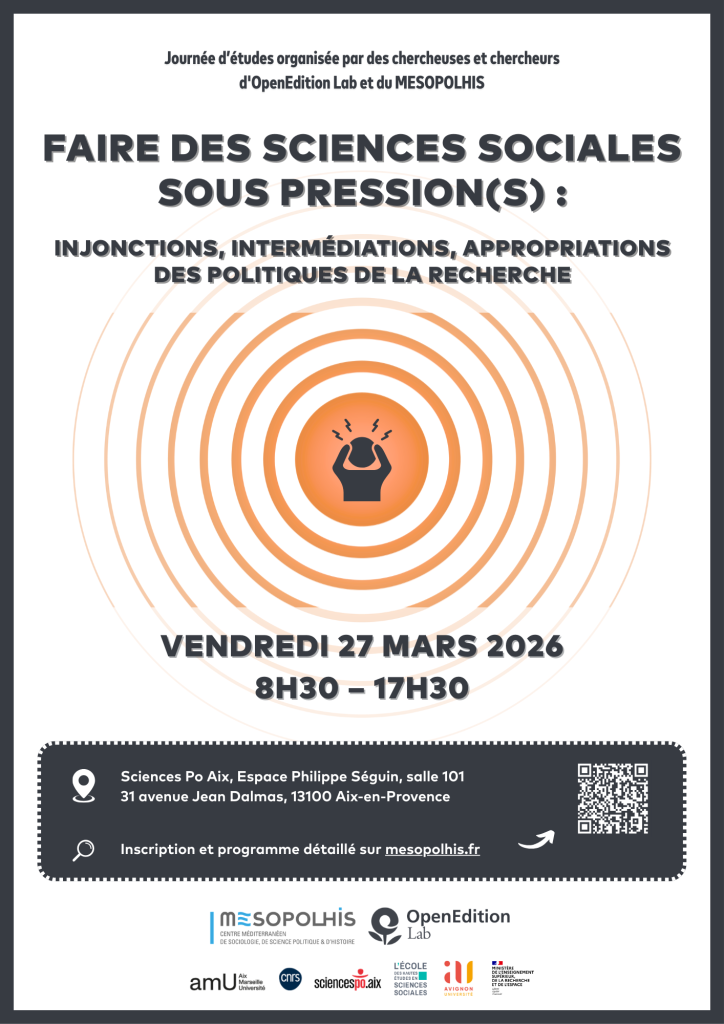
MESOPOLHIS / OpenEdition Lab study day: «Doing social sciences under pressure: injunctions, intermediations, appropriations of research policies».»
Details
Friday 27 March 2026 | 8.30am - 5.30pm | Sciences Po Aix, Espace Philippe Séguin, room 101 (Aix-en-Provence)
→ Face-to-face only.
→ Free but compulsory registration: https://framaforms.org/inscription-je-faire-des-sciences-sociales-sous-pressions-27-mars-2026-1773230590
Summary:
Over the last 20 years, successive science policy reforms have led to profound changes in the scientific field, which have been the subject of recent research. In this study day on 27 March 2026, organised by researchers from the OpenEdition lab and from Axis 6 of MESOPOLHIS, we have chosen to reflect more specifically on the political and bureaucratic regulation of the scientific field, in terms of injunctions, incentives, evaluations, redefinition of professional standards and excellence, recommendations, sanctions, valorisation, the ’fashion effect«, and so on. We are also interested in the effects of these mechanisms on scientific work and careers, and on the knowledge produced.
Sales pitch :
Over the past 20 years, successive science policy reforms have led to profound changes in the scientific field. Studies of the heteronomisation of research and the infringement of academic freedom take account of this context of transformation (Frangville et al., 2021; RogueESR, 2021, Aldrin et al., Gautier and Zancarini-Fournel, 2022, Cultures & conflicts, 2025). In Governing science. Anatomy of a reform (2004-2020), In France, sociologists Joël Laillier and Christian Topalov (2022) highlight the professionalisation of careers in scientific research management and the competition between universities based on national evaluation systems. However, these transformations, many of which stem from the new public management, are not unique to French higher education and research (ESR) (Musselin, 2021). Indeed, current events in the United States show how these steering instruments encourage a sometimes brutal submission of research to political logic (Fernandez and Hutchens, 2025). The regulation and supervision of scientific activity is taking on a variety of bureaucratic, legal and managerial forms (project-based funding, reform legislation, funding agencies, evaluation bodies, research infrastructures such as HAL, Progedo or OpenEdition) that are reconfiguring relations and practices in the scientific field.
Based on this observation, empirical research in the sociology of science is taking a fresh look at subjects relating to these public policies (Bérard and Roger, 2015). There is a growing body of work looking at recent changes in the field of science. These analyses examine, for example the watchwords on interdisciplinarity in France and the “properly epistemological compromises” that result (Lagier, 2025), the placing of “academic freedom” on the agenda by a variety of players (academics, political players, activist groups, journalists) (Boncourt, 2024), the resistance to ethics regulation policies in sociology over the last fifteen years (Dingwall and Vassy, 2025) and to legal proceedings (Laurens, 2022), the differentiated management of scientific misconduct issues within universities (Boncourt, Mirman and Michalon, 2025), the negotiation of authorisations with the Defence Security Officer (FSD) for sensitive areas (Duclos, 2023), the cumulative effects of regulations on ethics, “integrity” and “open science” (Siméant-Germanos, 2022), incentives to share research data in tension with competing professional standards and dedicated infrastructures (Levain et al., 2023; Zurbach, 2024), university management indicators that reproduce the hierarchies of legitimacy between disciplines (Rowell, 2022), or the “participative” inclusion of society (Lefevre et al., 2026).
The variety of ways in which the scientific field is governed, more or less imposed, more or less exogenous, extends beyond the issues dealt with in the above-mentioned studies. policy-oriented, All these factors have an impact on the trajectories and careers of scientists. All these factors have an impact on scientists“ careers and career paths (Hermanowicz, 2007; 2009), as well as on the mechanisms for reproducing inequalities and forms of domination in science, which have long been studied (Bourdieu, 1984; Merton, 1968). The sociological properties of researchers can be analysed in order to understand how they internalise the constraint, make it their own, come to terms with it while suffering (Le Lay, 2012), ”bifurcate' (Bontems and Gingras, 2007), go through a scandal (Ragouet, 2014) or come to terms with the relationships of domination in the field (Renisio, 2015).
On the one hand, we have chosen to look more closely at the mechanisms of political and bureaucratic regulation of the scientific field, whether in the form of injunctions, incentives, evaluations, redefinition of professional standards and excellence, recommendations, sanctions, valorisation, «fads», etc. On the other hand, we are interested in the effects of these mechanisms on scientific work and careers, and on the knowledge produced. Secondly, we are interested in the effects of these measures on scientific work and careers, and on the knowledge produced. How do researchers negotiate their relationship with these mechanisms and the constraints (or resources) they generate? What do they actually do to the research activity? Submission, support, appropriation, negotiation, diversion, avoidance and resistance are all factors that need to be analysed.
This study day will focus on the professional standards and forms of constraint produced by public policies relating to higher education and research (ESR) and which have an impact on the scientific field, and on the effects of these public ESR policies on the knowledge produced, scientific activities and careers.
Programme :
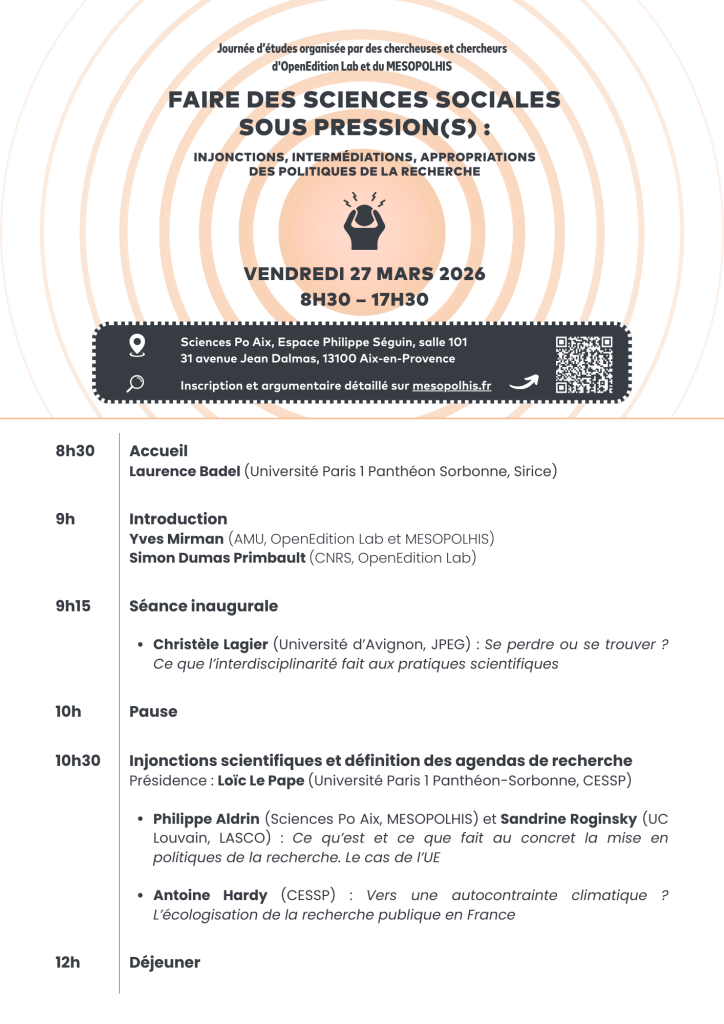
8H30 - Home
9.00AM-9.15AM Introduction
Yves Mirman, AMU, OpenEdition Lab and MESOPOLHIS
Simon Dumas Primbault, CNRS, OpenEdition Lab
9.15AM - 10.00AM Opening session
Speech (30 min) : Christèle Lagier, University of Avignon, JPEG
“Getting lost or finding yourself? What interdisciplinarity does to scientific practice”.”
Group discussion
10.00-10.30 AM - Break
10.30AM - 12.00PM Scientific imperatives and the definition of research agendas
Talk (20 min) : Philippe Aldrin, Sciences Po Aix, MESOPOLHIS
Sandrine Roginsky, UC Louvain, LASCO
“What research policy is and what it does in practice. The case of the EU”.”
Talk (20 min) : Antoine Hardy, CESSP
“Towards climate self-constraint? The greening of public research in France”.”
Chairing the meeting : Loïc Le Pape, University of Paris 1 Panthéon-Sorbonne, CESSP
Group discussion
12.00 - 1.30 PM Lunch
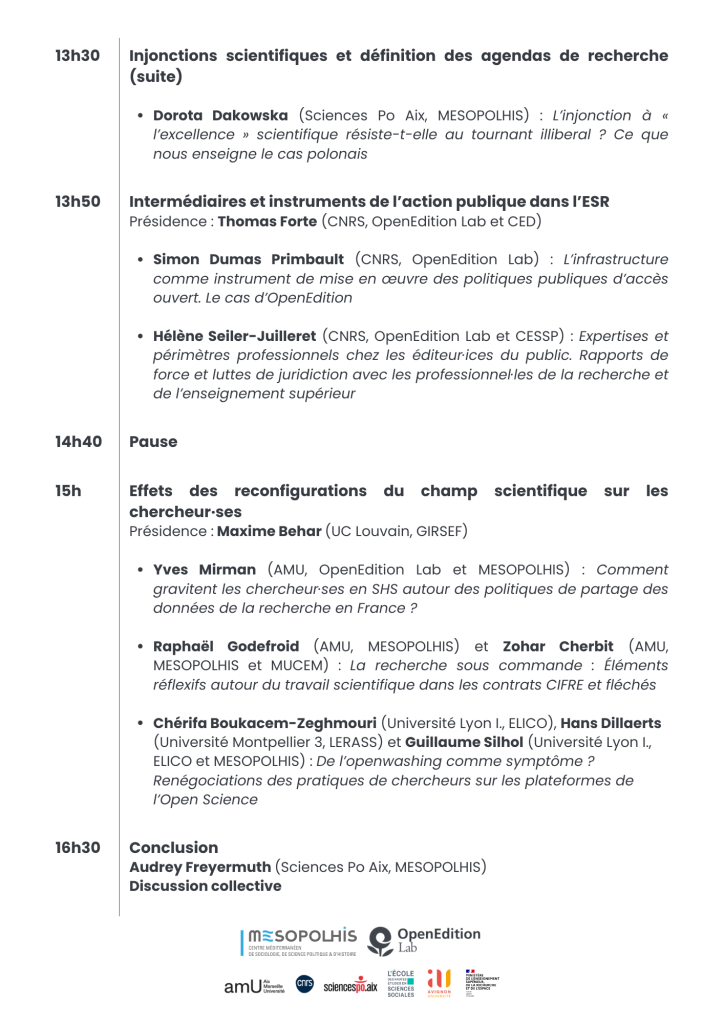
1.30 PM - 1.50 PM Scientific imperatives and the definition of research agendas (continued)
Talk (20 min) : Dorota Dakowska, Sciences Po Aix, MESOPOLHIS
“Does the injunction to scientific «excellence» resist the illiberal turn? What the Polish case teaches us”.”
1.50PM-2.40PM Intermediaries and instruments of public action in higher education
Talk (20 min) : Simon Dumas Primbault, CNRS, OpenEdition Lab
“Infrastructure as an instrument for implementing public open access policies. The case of OpenEdition”.”
Talk (20 min) : Hélène Seiler-Juilleret, CNRS, OpenEdition Lab and CESSP
“Expertises et périmètres professionnels chez les éditeur-ices du public. Power relations and jurisdictional struggles with research and higher education professionals”.”
Chairing the meeting : Thomas Forte, CNRS, OpenEdition Lab and CED
Group discussion
2.40PM-3.00PM - Break
3.00 PM - 4.30 PM Effects of the reconfiguration of the scientific field on researchers
Talk (20 min) : Yves Mirman, AMU, OpenEdition Lab and MESOPOLHIS
“How do SHS researchers gravitate around research data sharing policies in France?”
Talk (20 min) : Raphaël Godefroid, AMU, MESOPOLHIS
Zohar Cherbit, AMU, MESOPOLHIS and MUCEM
«La recherche sous commande : Éléments réflexifs autour du travail scientifique dans les contrats CIFRE et fléchés».»
Talk (20 min) : Chérifa Boukacem-Zeghmouri, Lyon I University, ELICO
Hans Dillaerts, University of Montpellier 3, LERASS
Guillaume Silhol, Lyon I University, ELICO and MESOPOLHIS
“Openwashing as a symptom? Renegotiating researchers” practices on Open Science platforms".”
Chairing the meeting : Maxime Behar, UC Louvain, GIRSEF
Group discussion
16H30-17H00 - Conclusion
Speech (15 min) : Audrey Freyermuth, Sciences Po Aix, MESOPOLHIS
Group discussion
More information on Calenda.
See more