Area 5: 2nd «Safety, Biomedicine and International Relations» conference»
31mar15 h 00 min18 h 00 minArea 5: 2nd «Safety, Biomedicine and International Relations» conference»
Details
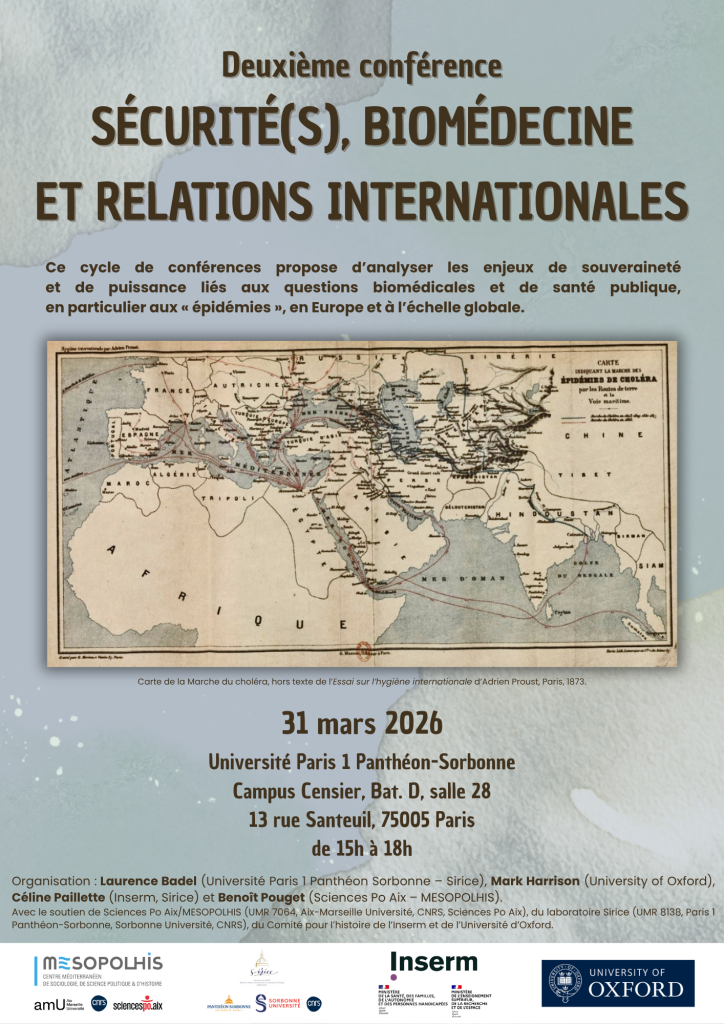
Tuesday 31 March 2026 | 15h - 18h | Université Paris 1 Panthéon-Sorbonne, Centre Censier, Bat. D, room 28 (13 rue Santeuil, Paris 5e)
⚠️ Registration required (before 12 noon on Friday 27 March): please contact benoit.pouget[at]sciencespo-aix.fr
Conference organised by Laurence Badel (University of Paris 1 Panthéon Sorbonne - Sirice), Mark Harrison (University of Oxford), Céline Paillette (Inserm, Sirice) and Benoît Pouget (Sciences Po Aix - MESOPOLHIS) with the support of Sciences Po Aix/MESOPOLHIS (UMR 7064, Aix-Marseille Université, CNRS, Sciences Po Aix), the Sirice laboratory (UMR 8138, Paris 1 Panthéon-Sorbonne, Sorbonne Université, CNRS), the Inserm History Committee and Oxford University.
The conferences Safety(s), Biomedicine and International Relationss aim to analyse the issues of sovereignty and power linked to biomedical and public health issues, in particular «epidemics», in Europe and on a global scale. Microbial aggression has long been identified as a major, even structuring, factor in relations between peoples, powers and different parts of the world. It is seen as a challenge and an opportunity that can foster relations between powers. In addition to epidemics, other fields of biomedical research, public health and sanitary engineering will be mobilised in this new conference to address safety issues (blood products, nuclear disaster management, etc.).
The aim of the lectures is to place contemporary situations in the context of the «long term», to question biomedical and public health issues - research, public health policy, defence, security, armaments - by focusing on the state prism in the different phases and facets of globalisation. The conferences Safety(s), Biomedicine and International Relations analyse the classic questions about the exercise of sovereignty over a territory threatened by health risks and/or a threat to other powers, in the light of international flows and systems, including, alongside States, all types of players (private and public organisations, etc.) in health safety governance processes.
The aim of the conferences is to gain a better understanding of the diplomatic processes involved in the «resilience» of powers in the face of health crises and the possible geostrategic shifts involved.
Programme :
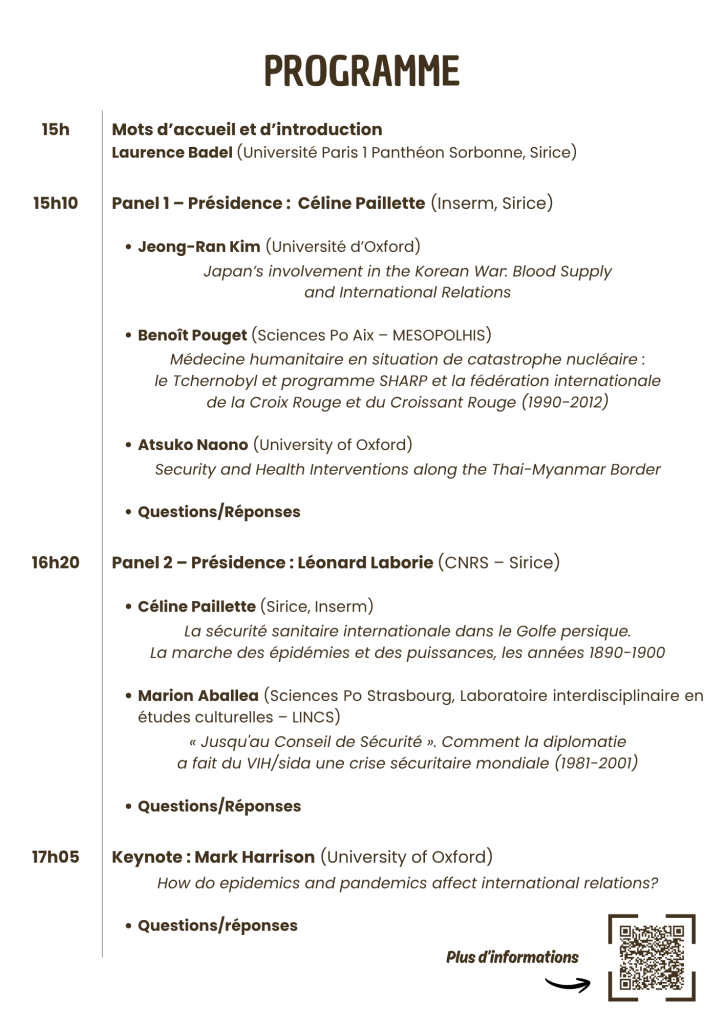
3pm - Welcome and introductory remarks
Laurence Badel (University of Paris 1 Panthéon Sorbonne, Sirice)
3.10pm - Panel 1 - Chaired by Céline Paillette (Inserm, Sirice)
- Jeong-Ran Kim, University of Oxford : Japan's involvement in the Korean War: Blood Supply and International Relations
- Benoît Pouget (Sciences Po Aix, Mesopolhis): Humanitarian medicine in nuclear disaster situations: the Chernobyl and SHARP programme and the International Federation of the Red Cross and Red Crescent (1990-2012)
- Atsuko Naono, University of Oxford : Security and Health Interventions along the Thai-Myanmar Border
Questions
16h20 - Panel 2 - Chaired by Léonard Laborie (CNRS, Sirice)
- Céline Paillette (Sirice, Inserm): International health security in the Persian Gulf. The march of epidemics and powers, the years 1890-1900
- Marion Aballea, Sciences Po Strasbourg, Interdisciplinary Laboratory in Cultural Studies (LINCS): «All the way to the Security Council. How diplomacy turned HIV/AIDS into a global security crisis (1981-2001)
Questions
17h05 - Keynote
Mark Harrison, University of Oxford : How do epidemics and pandemics affect international relations?
Questions
Download PDF document :
See more