Book by Lucas Faure: «Les ONG humanitaires musulmanes en France. Gouverner le social par le religieux».»
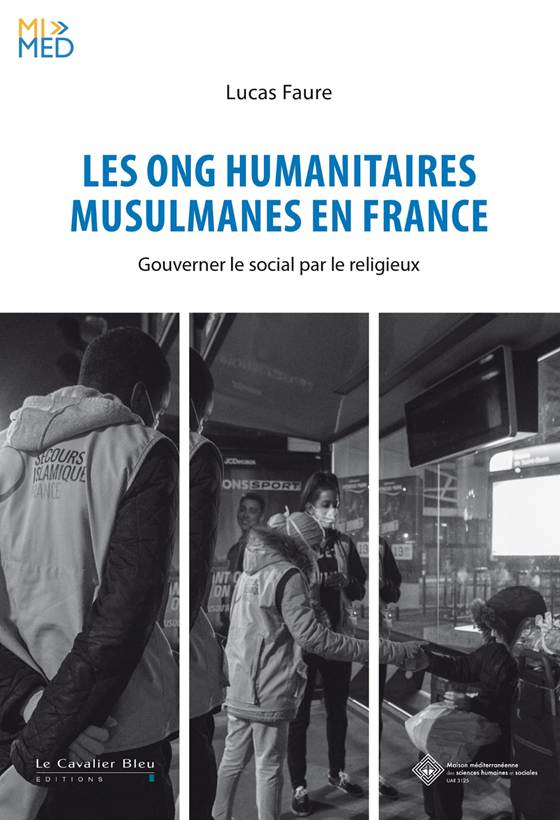
Lucas Faure, Muslim humanitarian NGOs in France. Religious governance in the social sphere, Le Cavalier Bleu Editions, collection Mimed, February 2026, 312p. (ISBN: 979-10-318-0827-7)
Presentation:
Since the 2010s, Muslim humanitarian NGOs have emerged as the most dynamic players in the Muslim community: they are involved in local solidarity networks through a range of activities (food distribution, outreach work, emergency accommodation, educational support, administrative assistance, etc.), while at the same time running international humanitarian programmes.
Through its socio-historical and ethnographic approach, the book sheds new light on Islamic humanitarianism in France, in a secularised, minority and competitive environment marked by state interventionism. Immersing ourselves in the heart of Islamic humanitarianism gives us a concrete insight into the activities of these NGOs, breaking with the common representations associated with the subject. Contrary to the republican rhetoric which stigmatises denominationalism, the State delegates to Muslim NGOs a particularist management of Muslim publics. Recognition in the name of denominational usefulness is countered by denominational stigmatisation, which places Muslim humanitarian NGOs in a relationship of useful subordination to the State. A paradoxical injunction is therefore issued to Muslims, who have to be «Muslim but not too Muslim».
Lucas Faure has a doctorate in political science. His research was awarded the 2024 MMSH Aix-en-Provence thesis prize and the Rémy Leveau 2025 Prize from the GIS Middle East and Muslim Worlds on Islam in France and Europe.
Contents
Introduction: Muslim but not too Muslim
Methodology: ethnographic immersion in French Muslim NGOs
Islamic humanitarianism: an overview
Governing the social by the religious: a political sociology of the links between the State and Islam
Demonstrating «good faith»
The birth of Islamic humanitarianism in Europe
«Out of sight, out of mind»: informal solidarity in the context of migration (1950-1980)
The formation of European Muslim diasporas and the globalisation of aid (1981-2000)
The deployment of a European Muslim humanitarian (2001-present)
«Sweeping in front of one's own door». Promoting local and patriotic Islamic charity
Overcoming the classic opposition between the French and British cases
From global to local: how should aid be prioritised?
A patriotic Muslim humanitarian
Constrained loyalties: Muslim NGOs and public authorities
Divided Muslim humanitarian movements
«Attesting» and «contesting»: relational positions
A paradox of state delegation
Politics through humanitarianism: Muslim humanitarian leaders
Humanitarianism: social properties and biographical availability
De-politicising humanitarian aid to ensure long-term commitment
Cumulative learning from political constraints
«Fissabililah has a good back». Gender logic in Islamic humanitarian aid
Why get involved?
Being a veiled employee of a Muslim NGO: professional emancipation through humanitarian work
A career in humanitarian aid
Fair pay« for humanitarian work
From salaried employment to voluntary work: the need for «free work»?
The NGO start-up: a place for professional and religious fulfilment
The director of the SIF branch in Lyon: internal control of a «good» religiosity
Humanitarian aid: a restrictive refuge for women
«No religion outside the truck». Donation, Islam and public space
From the urban fringes to town centres: a distant public space
Achieving neutrality in the eyes of all
An assignment that sticks to your skin
The difficulty of managing an affinity audience
Conclusion
NGOs at the public authorities' bedside
Mobilising in the shadow of the secular norm
The carrot and the stick: a pattern set to extend beyond Muslim NGOs?
Appendix
Bibliography
Share on
Read also