Marc Bernardot, Clôtures. Sociologie du confinement et de l'effacement. Collection K, TERRA-HN-éditions, 2023
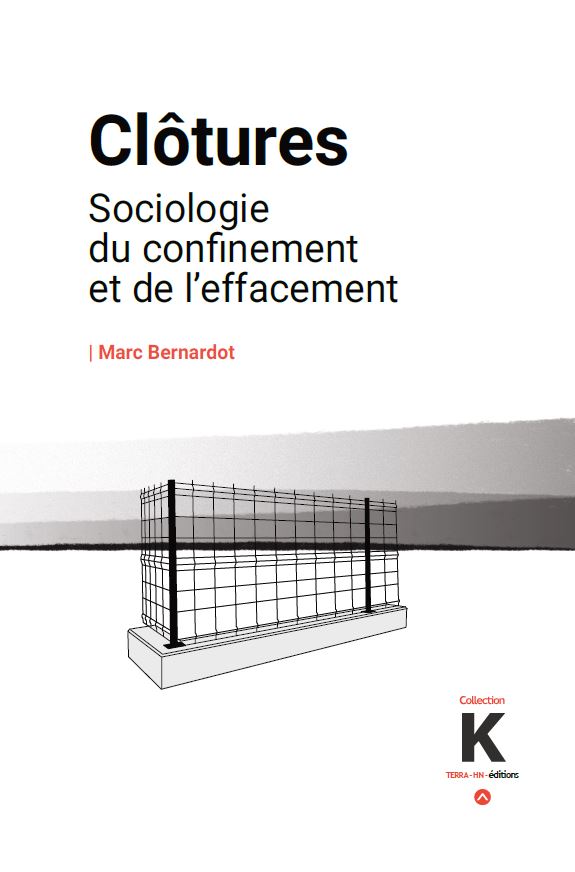
With the support of MESOPOLHIS and the Institut Sociétés en Mutation en Méditerranée (SoMuM), Marc Bernardot's book, Fences. Sociology of containment and erasureCollection K, TERRA-HN-éditions, 2023, ISBN 979-10-95908-04-3, licence CC-BY-NC-ND 4.0will be available in open access and in full text at the publisher's website in April 2023.
Summary. This digital work is the second part of a triptych. Following on from Capturespublished in 2012, which examined the policies of arrest and deportation of illegal migrants, it looks at different places of confinement, including hostels and camps, and the traces left by these enclaves and their occupants. It was written before the recent pandemic, bringing together texts written between 2006 and 2016. It evokes the confinement of 'others' before it becomes widespread in 2020. It is both a socio-history of these forms of relegation, seeking to retrace the lines of a scattered genealogy of contemporary ostracism, and a socio-political account of the interactions of relegated groups with the specific policies applied to them, Fences provides some answers to the questions raised by illiberal practices in liberal societies. The final volume, entitled Évasions, will soon deal with contemporary forms of emancipation.
Keywords. Homes, camps, traces, confinement, urbicide, otherness, coloniality, emancipation, sociology
Abstract. This digital book is the second volume of a triptych. Following on from Capturespublished in 2012, which questioned the policies of arrest and deportation of illegalized migrants, it deals with different places of confinement, notably single men hostels and internment camps, and the traces left by these enclaves and their occupants. It was written before the recent pandemic as it gathers texts written between 2006 and 2016. Rather, it evokes the confinement of "others" before it is generalised in 2020. Both a socio-history of these forms of relegation by seeking to trace the lines of a scattered genealogy of contemporary banishment and a socio-political account of the interactions of segregated groups with the specific policies applied to them, Clôtures provides some answers to the questions raised by illiberal practices in liberal societies. The last volume, entitled Evasions, will soon deal with contemporary forms of empowerment.
Keywords. Single men hostels, camps, traces, containment, urbicide, otherness, coloniality, empowerment, sociology
Biography. Marc Bernardot is professor of sociology at Aix-Marseille University and director of the research unit MESOPOLHIS (AMU, Science Po Aix, CNRS). His current research focuses on the languages of globalisation. The author of several books and numerous articles on migration and urban policies, he recently published L'architexte liquide du travail digitalisé (2022), in Rhetoric, metaphor and digital technologiesE. Caccamo & M. Bonenfant, (eds.), Presses universitaires du Québec.
Biography. Marc Bernardot is full professor of sociology at Aix-Marseille University and head of the MESOPOLHIS research unit (AMU, Science Po Aix, CNRS). His current work focuses on the languages of globalisation. Author of several books and numerous articles on migration and urban policies, he recently published in 2022, "L'architexte liquide du travail digitalisé", in Rhetoric, metaphor and digital technologiesE. Caccamo & M. Bonenfant, (eds.), Presses universitaires du Québec.
Share on
Read also